
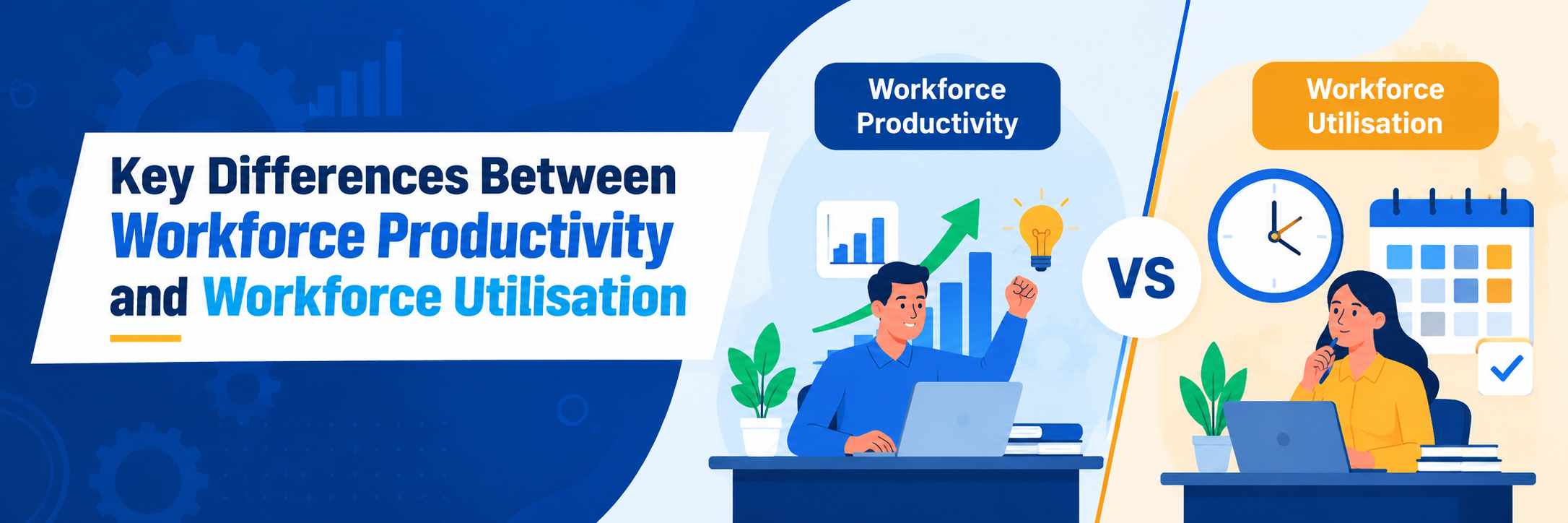
People often use workforce productivity and workforce utilisation interchangeably. But they do have separate meanings and functions. To remain agile and achieve operational efficiency, organisations need to understand the key differences between the two. Understanding the difference between workforce productivity and workforce utilisation assists businesses in identifying performance gaps, allocating resources effectively, and making data-driven workforce planning decisions.
Established in 1984, Yashaswi Group is a leading temporary staffing solution and contractual manpower service provider in Pune. It supports organisations across industries in finding their right candidate. Yashaswi is also a skill development centre in Pune, India, offering various skilling initiatives.
What is Workforce Productivity?
Workforce productivity means how employees use their time, skills and resources to complete tasks, meet targets, and contribute to overall business growth.
Why is Workforce Productivity Important?
1) It supports faster decision-making by using insights to make informed strategic choices.
2) Optimises operational efficiency by reducing disruptions and improving workflows.
3) Strengthens business performance backed by better outcomes.
4) Boosts employee experience and fosters a collaborative work environment.
Which are the Workforce Productivity Metrics to Track:
1) Revenue generated per employee.
2) Efficiency of resource utilisation.
3) Time to complete projects and tasks.
4) Quality of work produced.
What is Workforce Utilisation?
Workforce utilisation means how an organisation uses its assets, i.e, employees’ working hours. It shows how much time employees spend on productive, billable, or value-adding tasks compared with their total working hours.
Why is Workforce Utilisation Important?
1) It supports identifying underused employees or teams.
2) Promote sustainable workloads.
3) Enhances staffing decisions and business objectives.
4) Aligns workforce capability and capacity with operational demands.
Which are the Workforce Utilisation Metrics to Track:
1) Billable workforce utilisation rate.
2) Workforce productivity index.
3) Time spend on value adding tasks.
4) Idle time measurement.
| Tracking Factor | Workforce Productivity | Workforce Utilisation |
|---|---|---|
| Primary Focus | Output and value generation | Use of available human capital |
| Key Question | How much value or work is produced? | How much available time is utilised? |
| Key Metric | Output relative to inputs | Used time relative to available time |
| Example KPI | Tasks completed per hour | Percentage of time assigned to work |
| Common Challenge to Tackle | Low output or poor quality | Idle capacity or excessive workload |
Workforce Productivity vs Workforce Utilisation: What are the Clear Distinctions?
The major difference between the two is what each metric measures. Productivity focuses on the workforce’s final output and value generation, while utilisation focuses on how the workforce’s working time or capacity is being used.
Why Both Metrics Matter and How to Track Them?
Tracking and having a data-based compilation of both metrics will provide organisations with a comprehensive view of operational performance. This will assist in the identification of resource allocation gaps and idle human capital. Low utilisation may suggest insufficient demand or an uneven workload. Productivity metrics will highlight process insufficiencies and skill gaps or inadequate usage of tools. By combining these metrics, organisations can enhance their workforce planning, cost management and employee development.
Practices to Maximise Workforce Productivity and Utilisation:
1) Define role-specific performance goals aligned with business growth.
2) Leverage workforce analysis to monitor workforce usage, work quality, and the time taken to produce the work.
3) Allocate resources as per role-demanded skill expertise and project requirements.
4) Equalise workload to prevent workforce burnout, while avoiding idle capacity.
5) Review performance quarterly by utilising workforce data analytics.
Conclusion:
Both of the metrics complement each other and support organisations in understanding their workforce gaps, requirements and operations. Productivity measures the final output, while utilisation measures how much capacity is being used. For sustainable growth, organisations should monitor both metrics alongside work quality, employee well-being, and customer outcomes.
Here are some Frequently Asked Questions (FAQ’s):
1) What is the difference between workforce productivity and workforce utilisation? ?
Workforce productivity measures final output, while workforce utilisation measures how much workforce capacity is used.
2) Why are workforce productivity and utilisation important for businesses?
Both metrics help businesses improve operational efficiency, allocate resources, manage costs, identify idle labour, and make informed workforce planning decisions.
3) Which workforce productivity metrics should organisations track?
Organisations must track productivity metrics such as revenue generated per employee, resource utilisation, total length of time from start to finish, and, lastly, quality of final output.
4) How can businesses improve workforce utilisation?
Organisations can improve workforce utilisation by balancing workloads, monitoring billable hours, reducing idle time, and aligning employee skills with operational demands.
5) How can organisations measure workforce productivity and utilisation together?
Organisations can combine output, work quality, billable utilisation, and idle-time metrics to identify skill gaps, improve workforce planning, and support sustainable business growth.