
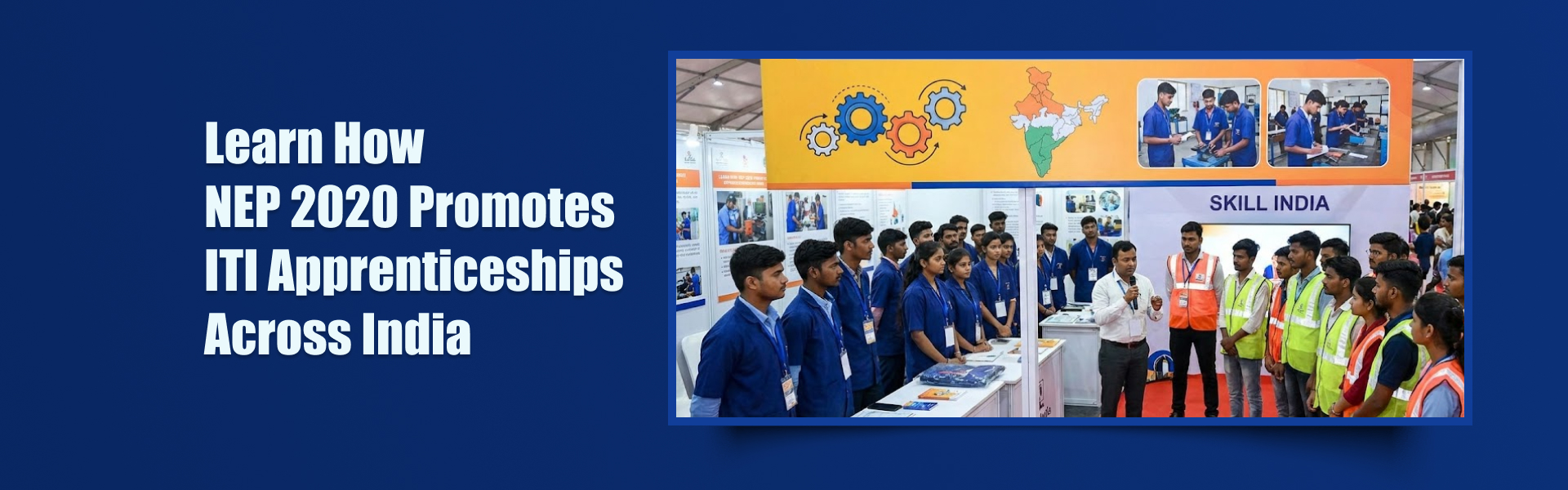
India’s educational sphere is transforming because of the National Education Policy (NEP) 2020. The NEP 2020 policy prioritises practical learning, vocational pathways and Skill Development Centres across India to achieve employment. NEP 2020 is reshaping how youth prepare for careers, especially those entering Industrial Training Institutes (ITIs). This shift is not just limited to education reform but is now strengthening India’s apprenticeship ecosystem and creating a more job-ready workforce for modern industries.
What is NEP 2020?
The NEP 2020 policy is one of India’s revolutionary educational policies. It aims to transform India’s education system by making it more accessible, equitable and of high quality. It focuses on preparing students for modern challenges by adapting vocational education and intends to foster critical thinking, creativity, problem-solving, comprehension and multidisciplinary learning.
This shift enables students to move beyond the classroom’s theoretical learning to real-world industry environments, aligning with the requirements of the 21st century.
Highlights of NEP 2020:
- Integrates industry-based skilling and learning.
- Introduces vocational exposure from early schooling.
- Offers flexibility to choose their learning trajectories.
- Allows students to choose between vocational and academic streams.
- Opens doors for skilling, upskilling, apprenticeships and connects deeply with Skill Development Centres across India.
How NEP 2020 Strengthens ITI Apprenticeship Training
1) Addresses Skill Shortage in India
India faces a massive skill gap across sectors like manufacturing, construction, and electronics. NEP 2020 resolves this by emphasising industry-led training, continuous skilling and upskilling.
The government’s National Apprenticeship Promotion Scheme (NAPS) further encourages industries to hire and train apprentices, making practical training accessible across sectors.
This shifts theoretical learning to practical training, and ITI apprenticeships become the best source for qualified professionals.
2) Integrates Skill-Based Education
The NEP 2020 policy integrates skill-based education into mainstream schooling from an early age. Students can choose various trades and vocational subjects early on.
This helps them gain industry-relevant skills and understand different career pathways.
ITI trades are known to be skill-focused and aligned with the expanding network of Skill Development Centres across India.
3) Combines Industry and Academia Learning
One of the greatest advantages of NEP 2020 is the drive to foster collaboration between educational institutions and industry. The policy encourages ITIs, apprenticeships, higher education institutions and employers to co-develop curricula that reflect real workplace requirements.
4) Promotes Vocational Learning
NEP 2020 aims to mainstream vocational education in India and lead to academic pathways.
It reduces the long-standing social stigma around non-academic courses and positions vocational training—especially ITIs and their apprenticeships—as promising career choices.
The policy actively encourages students to prioritise skill-based routes rather than traditional degrees.
5) Boosts Strong Social Perspective
A crucial impact of NEP 2020 is social empowerment. By promoting skilling and apprenticeships, particularly ITI apprenticeships, the policy supports India’s underserved population, mainly from the rural areas, i.e., tier 2 and tier 3 cities, where access to higher education is limited. For many young people, apprenticeships are a pathway to building a livelihood. The NEP 2020 strengthens this route by creating a bridge between education, employment, and financial independence.
Where To Apply for ITI Apprenticeships
Yashaswi is the first empanelled TPA by the Ministry of Skill Development & Entrepreneurship (MSDE) and a leading TPA that implements the apprenticeship training program in Pune.
We have helped thousands of youth turn their potential into progress by providing hands-on, industry-driven training in their chosen trades.
We empower youth with expert mentorship, on-the-job training, an industry-relevant curriculum and a monthly stipend.
Yashaswi also supports companies with temporary staffing and permanent staffing, enabling apprentices to transition into stable careers and long-term industry roles.
Employment Opportunities after ITI Apprenticeship
Below are industries where students can build careers after ITI apprenticeships:
- Retail
- Construction
- Logistics
- Manufacturing
- Supply Chain
- Electronics
- Hospitality & Catering
With NEP 2020 reforms, NAPS, and a strong network of Skill Development Centres across India, students gain better access to structured career pathways and long-term employment.
Conclusion
The NEP 2020 policy is not only improving employment opportunities but also building a society that is socially responsible. By promoting vocational education, NEP 2020 is strengthening ITI apprenticeships and enabling the youth of India to create a future-proof career. As industries continue to evolve and diversify, ITI apprentices will play a crucial role in shaping India’s skilled workforce.
Interested in enrolling for practical, modern ITI apprenticeship training?
Contact us: +91 7350014493 | 9552539602
Frequently Asked Questions (FAQ’s):
NEP 2020 introduces skill-based learning from early schooling, reducing stigma around vocational education and preparing students better for technical fields.
It is due to industry-aligned curricula, practical workshops, and upgraded training facilities that companies gain confidence that ITI apprentices are job-ready.
NEP 2020 prioritises skill training in leading sectors. By promoting industry-focused learning and apprenticeships, the policy ensures a steady supply of trained youth to match industry requirements
Yes. NEP 2020 is reducing the stigma around vocational education and apprenticeships and presenting it as an equally respectable and promising path, especially in rural and semi-urban regions.
ITI apprentices can enter diverse sectors, including manufacturing, logistics, construction, hospitality, retail, electronics, and supply chain management.