
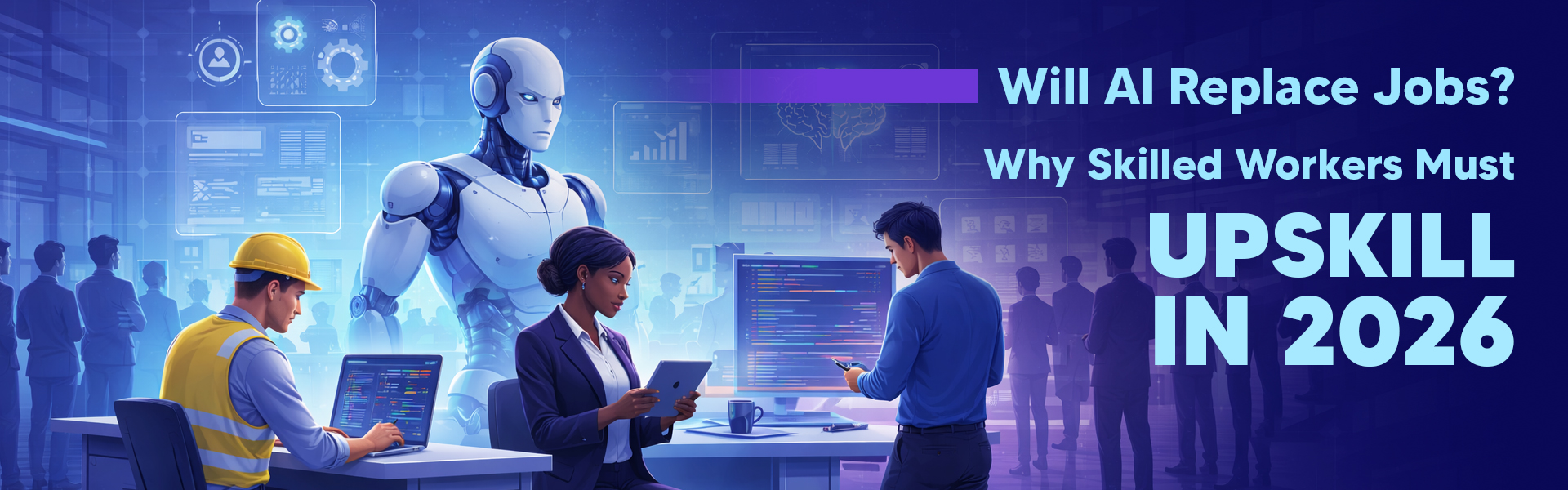
There is constant chatter about Artificial Intelligence (AI), driven mainly by fear – AI will replace jobs! The same conversations are being repeated as those heard during the Industrial Revolution. The fear that automated machinery would make human labour obsolete. Multiple channels are pushing the narrative that AI will sideline human contribution. However, this narrative misses a critical truth: AI will not replace skilled workers. Instead, it will reshape what it means to be skilled in the world of technological advancements.
The real competition is not between human skills vs artificial intelligence, but among workers who adapt to this shift and those who don’t!
Difference between AI and Skilled Workers
Artificial Intelligence (AI) is a machine tool that excels at performing repetitive, rule-based, and data-intensive tasks. From automating administrative processes to analysing large datasets, it is utilised to enhance efficiency. But efficiency is not the only edge that skilled workers possess.
Skilled workers are good at bringing content, judgement, creativity, leadership, strong problem-solving and collaboration abilities and qualities that AI cannot fully replace. Be it a writer writing a blog, a technician diagnosing a problem or a healthcare professional handling a critical patient, human expertise remains indispensable. AI just removes the routine tasks and leaves the core functions of the role to human prowess.
If Not AI, Then What is the Real Threat?:
Stagnation is the real danger, and precisely skill stagnation! Currently, industries are evolving at a high pace and tools, technologies, and processes are constantly being upgraded. Workers who solely rely on existing knowledge or the past learnt education without keeping up with today’s rapidity become irrelevant. It’s not because AI replaces them; rather, organisations require workers to adapt to these skills
The Rise of Augmented Workforces:
AI is not replacing workers; instead, it’s requiring the workforce to collaborate with machines/technology.
For Example:
1) The analyst who lets AI process thousands of data points and then interprets the strategies becomes more efficient.
2) The designer who uses AI to explore a hundred variations and then applies to choose the right one stays relevant.
3) A retailer who uses AI will efficiently analyse sales trends, customer behaviour and seasonal patterns to ensure they are stocked efficiently during peak demands are not harmed during prime time.
4) A manufacturer leveraging AI to predict machine failures before they occur minimizes their downtime and also avoids costly repairs.
In each given industry, you can surely notice the impact of AI on employment. AI is not replacing the skilled worker; instead, it’s transforming the way work is done. The demand is shifting toward individuals who can work alongside technology, interpret outputs, and make informed decisions.
How to Stay Relevant in the Age of AI:
Professionals must be well aware of the skills that will be in demand in their industry. They must adapt to the evolving technologies as per their industries. Here are some of the best ways to stay relevant in the age of AI:
1) Continuously upgrade your skills
2) Embrace new technologies
3) Develop core human skills like critical thinking and problem-solving
4) Always gain practical experience
5) Enroll in Skill Development courses
On the other hand, those who resist change or rely only on traditional methods may find themselves replaced, not by AI directly, but by individuals who know how to leverage it effectively.
Growing Demand for Cognitive Skills:
Cognitive skills are the core mental processes and abilities of the brain, mainly used for thinking, reasoning, learning, remembering and evaluating. Today, jobs require human skills that are beyond hard and soft skills; they value intellectual capabilities
In the age of AI, where everything is automated, cognitive skills are future workforce skills. Creativity, empathy, leadership, critical thinking, complex problem-solving, emotional intelligence, conflict resolution, strategic analysis, and ethical and moral reasoning are among the most valued skills. These skills are beyond AI’s comprehension and at times revolve around experience, social dynamics, trust, context, meaning and interpretation – a thing of human mind’s capability!
These skills are now widely recognised and actively pursued by organisations, as they remain uniquely within the domain of human expertise. Machines do not yet match human beings’ ability to understand nuances. Roles such as legal advisor, consultant and electrician can’t be automated as society needs humans to take responsibility.
Why Practical Skills Matter more Than Degrees?
Now, degrees alone no longer can provide you with employment. Employers are prioritising candidates who can demonstrate hands-on learning, those who understand tools, processes, and possess workforce readiness skills
This is where organisations such as Yashaswi Group play a vital role. They offer skill development programs in India, such as Apprenticeship Training Programs and Learn and Earn initiatives, that focus solely on providing industry skills training to youth. They bridge the gap between theoretical knowledge and practical learning, preparing individuals to meet evolving industry demands.
Conclusion:
Don’t wait to be replaced by change—lead it.
Join Yashaswi Group’s industry-focused skill development programs and gain the practical expertise companies are hiring for.
Start your journey toward a future-ready career today.
Here are 5 Frequently Asked Questions (FAQ’s):
AI will not replace skilled workers, but it will change the nature of the job, requiring individuals to adapt and work alongside evolving technologies.
The biggest threat is skill stagnation, as professionals who fail to upgrade their skills risk being replaced by those who adapt.
Cognitive and human-centric skills like critical thinking, creativity, emotional intelligence, and problem-solving are increasingly valued by organisations.
By continuously skilling upskilling, and reskilling and embracing technology, gaining practical experience..
Employers now prioritise hands-on experience and job readiness, as practical skills better reflect an individual’s ability to perform in real work environments.