
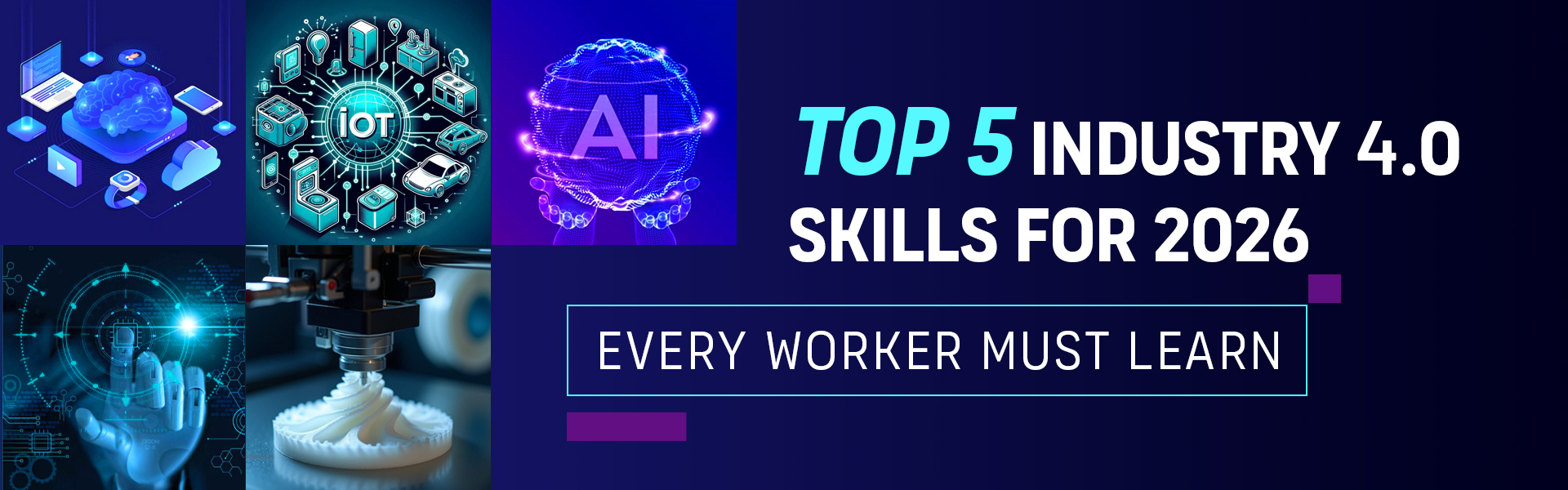
These Industry 4.0 skills are essential for future jobs and are becoming critical across manufacturing, IT, and service sectors. Today, the workplace is undergoing a seismic transformation. With the rise of automation, artificial intelligence, and connected systems, Industry 4.0 skills are no longer just a concept but a reality to master. Professionals need to adapt to the fourth industrial revolution skills as they are becoming essential for their daily work. Whether you work on the shop floor or in a corporate office, you must develop this bunch of smart factory skills to survive in this intense competition and to remain relevant and productive.
At its core, Industry 4.0 is about integrating digital technologies with traditional industries. This includes smart manufacturing, data-driven decision-making, and real-time communication across systems. As roles evolve, so must the workforce’s capabilities.
At Yashaswi Group, we focus on helping students and professionals develop Industry 4.0 skills through practical training and real-world exposure.
Here are some of the important emerging job skills for 2026:
1) Digital Literacy
The base of Industry 4.0 is digital competence. Workers must be able to utilise digital tools, software and basic automation systems. This does not mean having a solid knowledge of advanced programming; instead, it’s about understanding how digital systems operate and how to interact with them for your benefit.
2) Internet of Things (IoT)
At the core of Industry 4.0 is the IoT. IoT is sensors/machines/devices that are connected to the internet all the time, that constantly share data. On the factory floor, it could be temperature sensors on machines, cameras, or wearables on workers, all providing live information to a central system. Every worker must know how to utilise IoT for their benefit and productivity, as it is one of the crucial skills needed for modern industry.
3) Artificial Intelligence (AI)
AI is no longer just present in sci-fi books; today, it’s predicting machine failures, optimising schedules and detecting quality defects. It is a technology that helps turn raw data into actionable insights. Every worker must know how to leverage AI in their role for optimised productivity. Familiarity with AI enables individuals to adapt better to evolving workplace technologies.
4) Data Analytics and Machine Learning
Raw data is of no use unless you can interpret it. Data analytics and machine learning are the engines that turn numbers into insights, as they are mainly focused on algorithms that learn patterns to predict insights. These two help analytics predict machine failures, optimise schedules and identify quality trends. These are the two most important technical skills for Industry 4.0, helping workers identify quality defects, machine performance, and optimise production schedules.
5) 3D Printing
Knowing 3D printing is another Industry 4.0 skill. This skill allows on-demand production of prototypes, jigs, fixtures, and even spare parts. For urgent requirements, this skill or tool helps teams design and print the components they need. Workers, with the help of a 3D printer, can quickly test and refine new designs, print custom or low-volume parts, and cost-effectively print customised tools, jigs or components.
6) Cognitive Skills
Alongside the above-mentioned technical skills, it is very important that workers strengthen their human cognition, i.e., soft skills. These are timeless human skills and will help you in the long run. Humans need to continuously enhance their problem-solving, decision-making, and communication skills. Strong cognitive skills help individuals to understand and respond to intense situations effectively. Whether it’s solving a problem at work, learning a new technology or making decisions under pressure, solid cognitive skills are essential for your performance.
Why Industry 4.0 Skills Are Important for Workers
Industry 4.0 skills help workers adapt to automation, improve productivity, and stay relevant in a rapidly evolving job market. Companies today prefer employees who can work with digital tools, analyse data, and make informed decisions.
Organisations like Yashaswi Group are actively bridging the skill gap by offering industry-oriented training programs that prepare candidates for modern manufacturing and digital roles.
Conclusion
Industry 4.0 is transforming the nature of work and presenting individuals with immense opportunities. Workers who will invest in building the right skills for their age will not only secure their roles but will also accelerate their career growth. The key lies in balancing technical knowledge with human skills and maintaining a proactive approach to learning. In this evolving landscape, the most successful professionals will not be those who resist change, but those who embrace it, adapt to it, and grow with it.
Start building these Industry 4.0 skills today to stay competitive in the future job market. Continuous learning and adaptability are the keys to long-term career success. If you are looking to build practical Industry 4.0 skills, Yashaswi Group offers specialised training programs designed to prepare you for real-world industry requirements.
Here are some Frequently Asked Questions (FAQ’s)
Industry 4.0 skills are a combination of digital, technical, and cognitive abilities that help workers operate effectively in the world of automation and AI.
Digital literacy enables workers to use software, automation tools, and digital systems efficiently, helping them stay productive and relevant in modern workplaces.
AI helps optimise processes, predict issues, and improve decision-making, allowing workers to increase efficiency, reduce errors, and enhance overall productivity.
Cognitive skills like problem-solving, critical thinking, and communication help workers handle complex situations, collaborate effectively, and adapt to constant technological changes.
Workers can start by learning digital tools, technologies, AI, and improving both technical and soft skills.